Color & Design

How to Layer Lumens: The Ultimate Guide to Room Lighting Levels

By Sarah Jenkins, Lead Interior ArchitectJune 17, 202611 min read

Lighting is one of the most powerful elements in interior design. It has the ability to make a small room feel spacious, highlight architectural features, and influence mood and productivity. Yet, lighting is often treated as an afterthought, resulting in rooms that are either under-lit and gloomy, or over-lit like a commercial office. To design a functional lighting scheme, you must understand the difference between watts (power consumed) and lumens (brightness emitted), and learn how to layer light based on the function of each room.

Designing a room's lighting requires blending mathematics with interior architecture. Simply hanging a single ceiling dome in the middle of a room creates harsh glare and dark corners, which contributes to eye strain and flat visuals. To create a warm, dynamic, and functional space, you must layer different light sources. In this comprehensive guide, we will analyze the three layers of lighting, review standards from the Illuminating Engineering Society (IESNA), and walk through lighting calculations and bulb selections.

The Three Layers of Lighting

A professional lighting layout combines three distinct layers of light to create visual depth and utility:

  • Ambient Lighting (General): The base layer of light that illuminates the entire room. Examples include recessed ceiling lights, chandeliers, or flush-mount fixtures. It provides safe navigation.
  • Task Lighting (Focused): High-intensity light targeted at specific work areas. Examples include under-cabinet lights in kitchens, desk lamps in home offices, or vanity lights in bathrooms.
  • Accent Lighting (Decorative): Used to highlight specific focal points, such as artwork, fireplaces, or bookshelves. Examples include track lights, picture lights, or wall sconces.

Understanding LED Efficiency and Lifespan

Modern lighting relies heavily on Light Emitting Diodes (LEDs). Unlike traditional incandescent bulbs that generate light by heating a filament (wasting 90% of their energy as heat), LEDs convert electricity directly into light, making them highly efficient. A standard 9W LED bulb emits the same 800 lumens of brightness as a 60W incandescent bulb, consuming 85% less energy. Furthermore, LED bulbs have an operational lifespan of 25,000 to 50,000 hours, compared to only 1,000 hours for incandescent models. When choosing LED bulbs, always look at the lumen output on the packaging rather than the wattage, as different manufacturers have varying efficiency levels.

IESNA Lighting Standards & Footcandles

The Illuminating Engineering Society of North America (IESNA) publishes footcandle guidelines for residential spaces. A footcandle is a measure of light intensity equal to one lumen per square foot. According to IESNA, hallways and stairs require 5 to 10 footcandles for safety. Living rooms and bedrooms require 10 to 20 footcandles for a relaxing atmosphere. Kitchen prep zones, home offices, and bathroom vanities require 40 to 50 footcandles for reading, food preparation, and grooming. To find the required lumens for any room, multiply the room's square footage by the recommended footcandles. Additionally, select bulbs with a Color Rendering Index (CRI) of 90 or higher to ensure paint colors and wood tones look natural.

Rules for Placing Task and Accent Fixtures

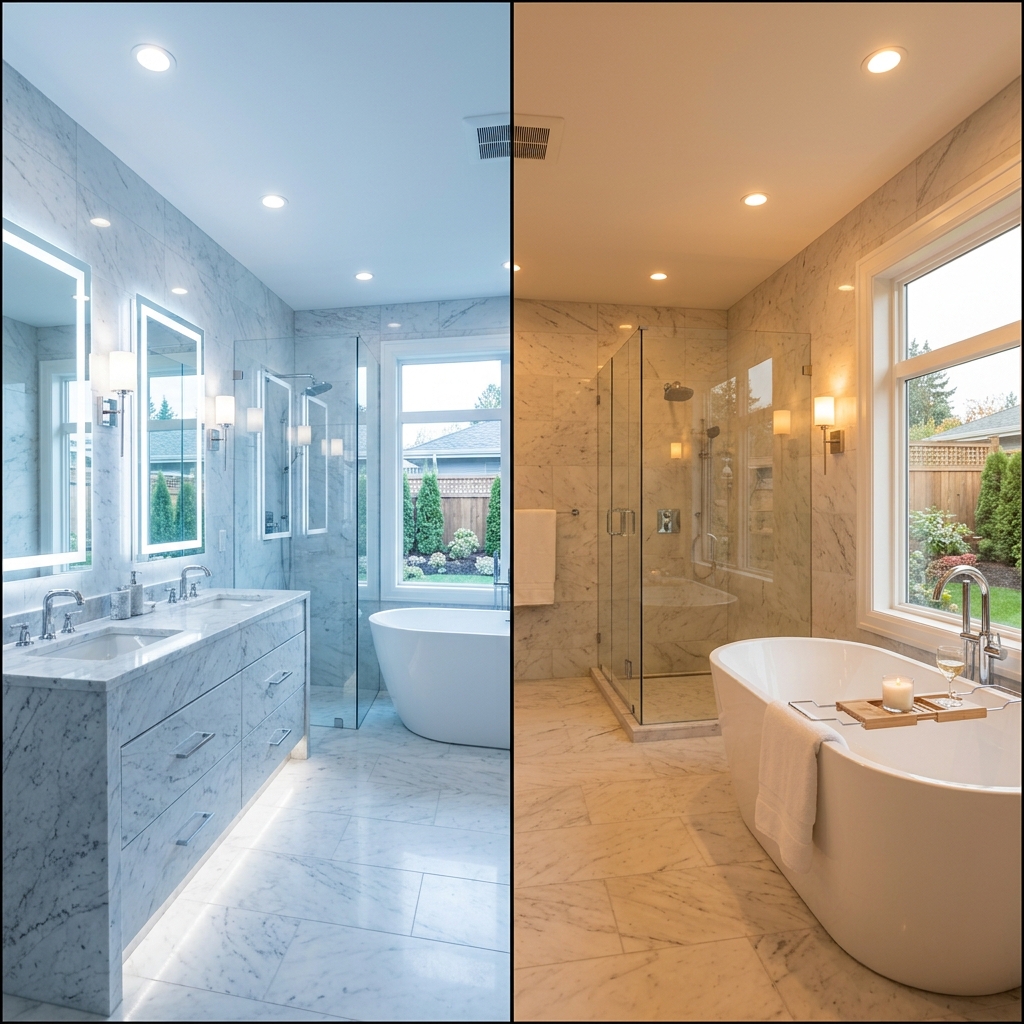
To avoid creating shadows or glare, task and accent fixtures must be positioned strategically. In the kitchen, mount under-cabinet LED light strips near the front edge of the cabinets rather than the back wall. This focuses light directly onto the countertop workspace. For bathroom vanities, avoid placing recessed downlights directly over the mirror, which casts deep shadows under your eyes and nose. instead, mount wall sconces on both sides of the mirror at eye level (about 60 inches from the floor) to wash your face in soft, shadow-free light. In dining rooms, hang chandeliers 30 to 36 inches above the table surface to provide intimate light without blocking sightlines across the table.

How to Calculate and Locate Fixtures

Follow these steps to build your room lighting plan:

  • Step 1: Calculate Room Area: Multiply the room length by the width in feet to find the square footage.
  • Step 2: Determine Required Lumens: Multiply the square footage by the recommended footcandles. (e.g. a 120 sq ft bedroom requires 120 × 15 = 1,800 lumens). You can calculate this using our Lumens Calculator.
  • Step 3: Choose Bulb Quantity: Divide the required lumens by the lumen output of a standard bulb. An 800-lumen LED bulb (60W equivalent) is a common standard.
  • Step 4: Distribute Fixtures: Space recessed lights evenly across the ceiling. Avoid placing lights too close to walls, which creates harsh shadows.
  • Step 5: Install Dimmer Switches: Dimmers allow you to adjust the lighting levels to match the time of day, transitioning from bright task light to soft ambient glow.

Understanding Color Rendering Index (CRI)

The Color Rendering Index (CRI) measures how accurately a light bulb reveals the true colors of objects compared to natural sunlight. The scale ranges from 0 to 100. Standard, low-cost LED bulbs often have a CRI around 80, which can make colors look dull, gray, or slightly green. For residential interiors, choose light bulbs with a CRI of 90 or higher. High-CRI bulbs make hardwood floors look richer, paint colors appear more accurate, and food look more appealing. By pairing the correct footcandle levels with high-CRI, warm white (2700K-3000K) bulbs, you create a comfortable, visually accurate lighting scheme that makes your home feel welcoming.

Understanding Color Temperature (The Kelvin Scale)

Selecting the correct color temperature is just as critical as choosing the right lumens. Color temperature is measured on the Kelvin (K) scale, ranging from 2,000K (a warm, candle-like amber) to 6,500K (a cool, blue-tinted daylight). For residential living areas, designers recommend bulbs in the 2700K to 3000K range. This 'Warm White' light mimics traditional incandescent bulbs, creating a cozy, relaxing ambiance that is ideal for bedrooms, living rooms, and dining spaces. In contrast, workspaces like home offices, kitchens, and garages benefit from 'Cool White' light in the 3500K to 4000K range. This higher Kelvin temperature stimulates alertness, reduces eye strain, and provides better contrast for reading and task-oriented activities. Avoid using 5000K or higher daylight bulbs inside residential living spaces; their high blue light content can feel clinical and harsh, and it can disrupt your body's production of melatonin, negatively impacting sleep quality if used in the evening.

LED Dimmer Compatibility and Flickering Solutions

Upgrading to LED lighting requires updating your dimmer switches as well. Standard dimmer switches designed for older incandescent bulbs work by cutting off parts of the electrical current. While this works perfectly for resistive filaments, it causes modern LED electronic drivers to flicker, buzz, or fail to dim fully. To resolve this, you must install electronic low-voltage (ELV) dimmers or LED-compatible (C-L) dimmers. These switches are engineered to regulate electrical current smoothly without causing interference. Additionally, when purchasing LED bulbs, verify that the packaging explicitly states 'Dimmable'. Non-dimmable LED bulbs will overheat and burn out quickly if connected to a dimmer circuit. Adding dimmer controls to your ambient and accent layers allows you to modify the mood of a room instantly, transforming a bright kitchen prep space into a soft, intimate dining area with a turn of a dial.

💡

Need to calculate measurements for your space?

Use our free, interactive Lumens Calculator to calculate dimensions, box requirements, or guidelines automatically.

Calculate Room Lumens
← Back to all blog posts