How to Accurately Estimate Concrete Yardage for a Custom Backyard Patio
Pouring a concrete patio requires ruthless mathematical precision. Unlike calculating hardwood flooring needs where you can easily run to the store for an extra box, a concrete pour is a ticking clock. Once the truck arrives and the mix starts flowing, you have about 90 minutes before the concrete cures. If you calculated your yardage incorrectly and the truck runs empty with a three-foot gap left in your patio forms, you have a massive problem. The 'cold joint' where you pour the second batch the next day will look terrible and crack almost immediately.
My Hands-On Experience with Short Pours
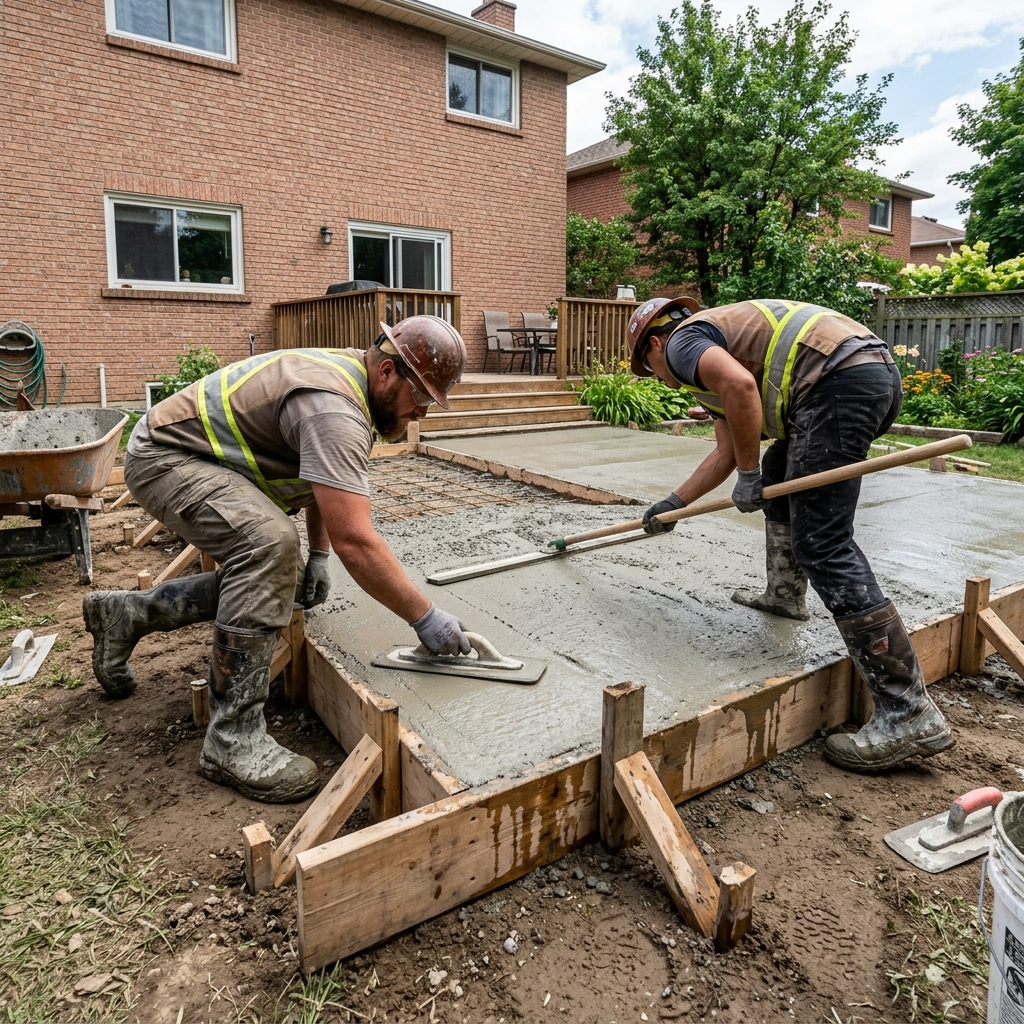
In the summer of 2024, I helped design a modern 20x20 foot backyard patio in Austin, Texas. We dug the forms out to a standard 4-inch depth. The math dictated exactly 2.46 cubic yards of concrete. The contractor decided to order exactly 2.5 yards to save money. He didn't account for the fact that the subgrade was uneven in the middle, dipping down to 5 inches deep. The truck ran completely dry with a two-foot square left unpoured in the corner. We had to frantically mix six 80-pound bags of concrete in a wheelbarrow by hand before the main slab cured just to save the project. That day cemented my rule: always order extra.
The Cubic Yardage Formula
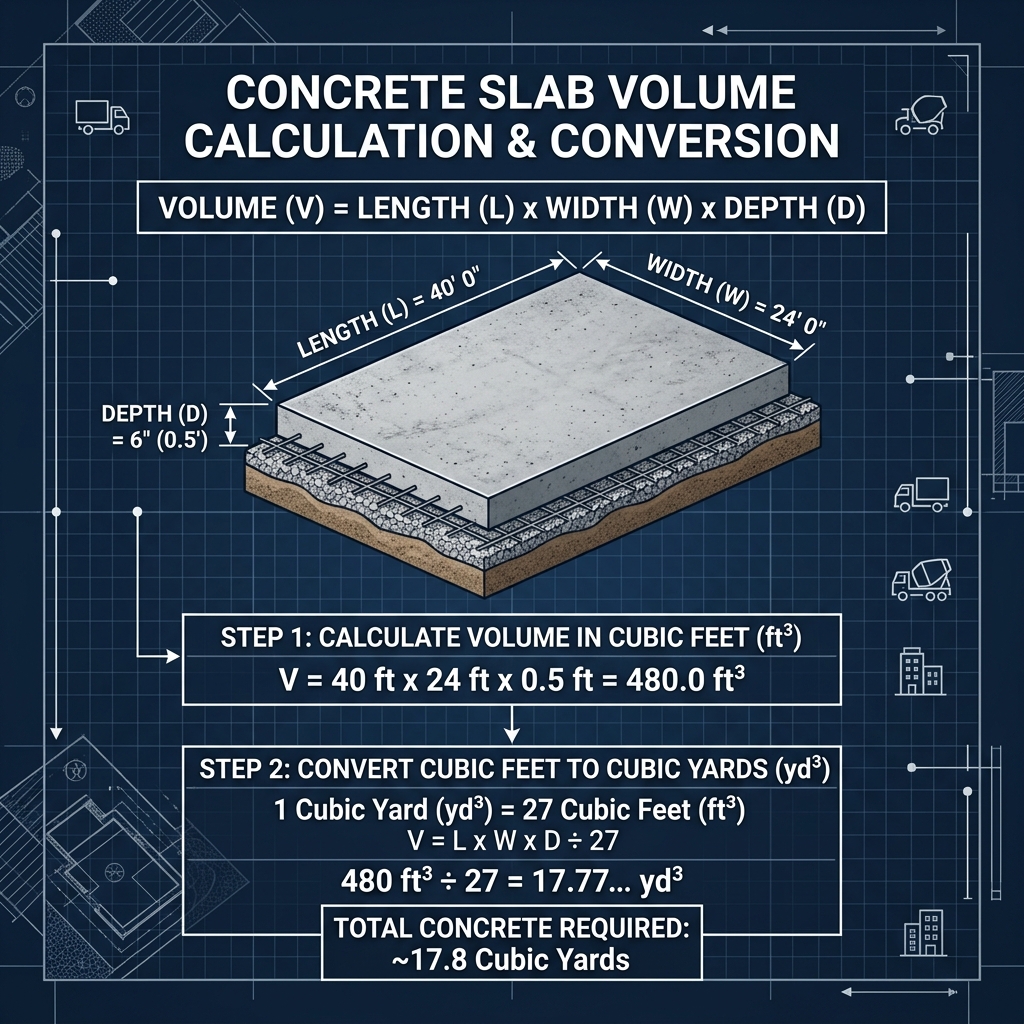
Concrete ready-mix companies sell material by the cubic yard, not by the square foot. A cubic yard is a block that measures 3 feet long by 3 feet wide by 3 feet high. To figure out how many cubic yards you need, you have to find the volume of your patio.
First, measure the length and width of your patio forms in feet. Let's say you have a 12-foot by 15-foot rectangle. Second, determine your depth. A standard walking patio requires a 4-inch depth. (If you plan to park a vehicle on it, the American Concrete Institute (ACI) mandates a 6-inch minimum depth). You must convert that 4-inch depth into feet so all your measurements match. Divide 4 by 12, which gives you 0.33 feet.
Multiply the length (12) by the width (15) by the depth (0.33). That equals 59.4 cubic feet. Finally, divide that number by 27 (because there are 27 cubic feet in one cubic yard). You get exactly 2.2 cubic yards.
The 10 Percent Golden Rule
You can never order exactly 2.2 yards. The ground you dug out is not perfectly flat. If your gravel base dips down an extra inch in the middle of the patio, that void swallows up concrete you didn't account for. The forms themselves might bow outward slightly under the heavy weight of the wet mix, consuming even more material.
The industry standard dictates that you must add a 10 percent waste margin to your final yardage number. Multiply 2.2 by 1.10, giving you 2.42 yards. You should round that up to the nearest quarter or half yard depending on what the ready-mix plant allows. Order 2.5 yards. The extra quarter yard might cost you $40, but running short costs you the entire patio.
Account for the Pump Truck
If your backyard is inaccessible to a heavy mixer truck, you will have to hire a concrete pump truck. The pump truck has a massive hopper that receives the wet concrete and pushes it through a hose over your house. The Concrete Foundations Association warns that a typical pump truck hopper holds almost a half-yard of concrete inside its machinery at all times. That concrete never makes it into your patio forms. If you are using a pump, you must add an extra half-yard to your total order just to prime the pump.
Need to calculate measurements for your space?
Use our free, interactive Flooring Calculator to calculate dimensions, box requirements, or guidelines automatically.
Calculate Your Base Area→